Florida Anti-Immigration Law 2025: Impact and Explanations
Florida Anti-Immigration Law 2025: 2026 Impact and What You Need to Know
The florida anti immigration law 2025 debate remains one of the most consequential legal and political battles in the Sunshine State. Florida passed several sweeping immigration enforcement measures in 2025 — and federal courts have continued to weigh in on key parts of them as we move through 2026.
Here is a quick breakdown of what these laws do and where things stand:
| Law | What It Does | Current Status |
|---|---|---|
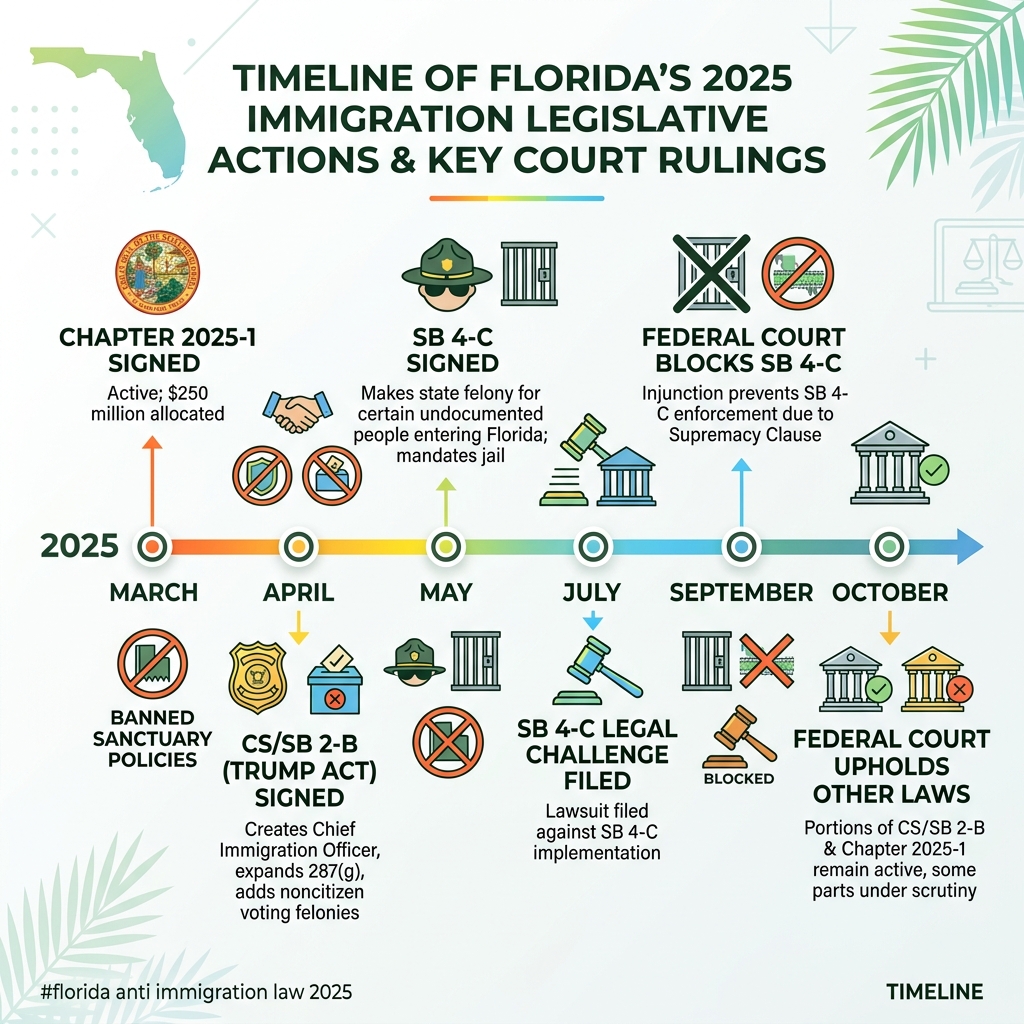
| SB 4-C | Makes it a state felony for certain undocumented people to enter Florida; mandates jail time before trial | Blocked by federal court injunction |
| CS/SB 2-B (TRUMP Act) | Creates a Chief Immigration Officer, expands 287(g) agreements, adds new felonies for noncitizen voting | Signed into law; portions face legal scrutiny |
| Chapter 2025-1 | Funds local law enforcement grants, bans sanctuary policies, mandates E-Verify | Active; $250 million allocated |
Key facts at a glance:
- 37 states passed at least 104 immigration-related laws in 2025
- Florida led a statewide operation arresting 1,120 undocumented immigrants in under a week during the initial rollout
- At least 27 people were arrested in Florida even after a federal judge blocked SB 4-C enforcement
- Federal courts have blocked similar state immigration laws in Texas, Oklahoma, Iowa, and Idaho — consistently citing the Supremacy Clause
The core legal issue is straightforward: the U.S. Constitution gives the federal government — not states — authority over immigration enforcement. That tension is at the heart of every lawsuit filed against these Florida laws.
One case brought this home in a jarring way. Juan Carlos Lopez Gomez, an American-born U.S. citizen, was arrested and held for 24 hours simply for crossing into Florida from Georgia under the new law. That story put a human face on the real-world consequences of state-level immigration enforcement gone wrong.
I’m Shay Williams — a retired U.S. Coast Guard Commander with over 30 years of experience in national security, counter-narcotics operations, and federal law enforcement coordination, giving me a understanding of the complex intersection of federal authority and local enforcement that sits at the center of the florida anti immigration law 2025 debate. I’ll walk you through what these laws actually say, what the courts have decided, and what it all means for Tampa Bay families and communities.
Understanding Senate Bill 4-C and the Florida Anti-Immigration Law 2025
When we look back at the legislative landscape of 2025, Senate Bill 4-C (SB 4-C) stands out as one of the most aggressive attempts by a state to regulate movement across its borders. This law was designed to create state-level criminal penalties for what has traditionally been a federal matter. Under SB 4-C, entering Florida as an undocumented person is no longer just a federal civil issue; it is a state crime.
The law targets individuals who enter Florida after eluding federal inspection. For a first offense, it carries a mandatory minimum of nine months in jail. If someone is caught a second time or has a prior deportation record, the penalties escalate quickly into serious felony territory. This shift toward criminalization is a major pillar of the florida anti immigration law 2025 strategy.
We have seen a significant push for these measures because state officials argue that federal enforcement has been insufficient. However, the broad reach of SB 4-C has caused concern even among those who support strong borders. Because the law focuses on “entry” into the state, it can affect people who have lived in the U.S. for years but happen to cross the state line after a trip to Georgia or Alabama.
To get a clearer picture of how these laws interact, we should look at the two primary pieces of legislation moving through Tallahassee. While SB 4-C focuses on the act of entering the state, the TRUMP Act (CS/SB 2-B) builds a massive administrative and enforcement framework around it. For more context on these changes, you can read our deep dive on Immigration in Florida 2025.
Key Penalties Under the Florida Anti-Immigration Law 2025
The penalties introduced in the florida anti immigration law 2025 package are designed to be a deterrent. Here is a breakdown of the specific consequences written into SB 4-C and related bills:
- Unauthorized Entry: A first-time arrest for entering Florida without federal inspection is a first-degree misdemeanor with a mandatory nine-month jail term.
- Felony Reentry: If an individual has been previously removed from the U.S. and enters Florida, they face a third-degree felony. Mandatory minimums range from one year to five years depending on their prior record.
- Capital Felony Reclassification: In a move that has drawn national attention, the TRUMP Act mandates the death penalty for unauthorized aliens convicted of certain capital felonies.
- No Bail Provisions: The law specifically prohibits diversion programs and requires that defendants be held without bond until their first appearance, where a judge must consider their immigration status.
Legislative Framework of the TRUMP Act
Beyond the individual penalties, the Tackling and Reforming Unlawful Migration Policy (TRUMP) Act, or CS/SB 2-B, creates a centralized “command center” for immigration enforcement within the state government. This is a massive shift in how Florida operates.
Under this act, the Commissioner of Agriculture is designated as the state’s Chief Immigration Officer. This role isn’t just symbolic; it grants the office the power to coordinate with federal agencies, manage grants for local police, and even declare immigration-related states of emergency. We also see the creation of the Office of State Immigration Enforcement, which is tasked with ensuring that every corner of Florida’s government is aligned with these new mandates.
One of the most impactful parts of this framework is the strict E-Verify mandate. Employers are now under a microscope, with the state authorized to conduct audits and pull business licenses if they are found to be employing unauthorized workers. This is part of a broader effort to make Florida “unhospitable” for those without legal status.
| Provision | SB 4-C | CS/SB 2-B (TRUMP Act) |
|---|---|---|
| Primary Focus | Criminalizing entry into Florida | Administrative enforcement and state-federal coordination |
| New Roles | N/A | Chief Immigration Officer (Comm. of Ag) |
| Law Enforcement | Local arrests for state crimes | Grants for 287(g) and ICE cooperation |
| Employment | N/A | Strict E-Verify compliance and audits |
Legal Challenges and the Federal Block on SB 4-C
It didn’t take long for the florida anti immigration law 2025 to land in a courtroom. Almost immediately after SB 4-C was enacted, a coalition of advocacy groups, including the Florida Immigrant Coalition and the Farmworker Association of Florida, filed a lawsuit. They argued that the law oversteps state authority and violates the U.S. Constitution.
In April 2025, a federal judge issued a temporary restraining order (TRO), which was later extended into a preliminary injunction. The judge’s reasoning was rooted in two major constitutional pillars: the Supremacy Clause and the Commerce Clause. The court found that because the federal government has exclusive power to regulate immigration and interstate commerce, Florida cannot create its own “shadow” immigration system. You can view the full Federal Court Order Granting Florida TRO for the specific legal language used.
Constitutional Issues with Florida Anti-Immigration Law 2025 Enforcement
The primary legal hurdle for Florida is the doctrine of federal preemption. This was most famously addressed in the 2012 Supreme Court case Arizona v. United States, which struck down similar state-level enforcement efforts. The courts have consistently ruled that when a state law conflicts with federal immigration policy, the federal law wins.
What made the Florida case unique was the “defiant directives” issued by state officials. Even after the federal judge blocked the law, Florida Attorney General Ashley Uthmeier reportedly sent communications suggesting that local law enforcement could still proceed with certain arrests. This led to a sharp judicial rebuke, with the judge expanding the block to cover every potential victim of the law, not just the specific people named in the lawsuit.
Supreme Court Rulings and State Authority
As the case moved toward the higher courts, the U.S. Supreme Court issued a one-sentence order that left the block on the law in place. While some state officials pointed to the 2020 case Kansas v. Garcia—which allowed states to prosecute noncitizens for identity theft—to argue for more state power, the courts have generally seen SB 4-C as an unconstitutional “overreach.”
The message from the federal judiciary has been clear: states cannot arrest their way out of a federal policy disagreement. This has created a complicated situation for local officers in the Tampa Bay area, who are now caught between state mandates to enforce the law and federal court orders telling them to stop.
Enforcement Operations and the Role of State Agencies
Despite the legal blocks on SB 4-C, other parts of the florida anti immigration law 2025 package are moving forward. Florida has significantly ramped up its collaboration with the U.S. Department of Homeland Security (DHS) through programs like 287(g). This program allows local police officers to act as “mini” ICE agents, giving them the authority to check immigration statuses and process detainees for federal custody.
In May 2025, the state carried out a massive operation that resulted in more than 1,000 arrests. According to state reports, Florida’s statewide operation arresting 1,120 immigrants was the largest of its kind in the state’s history. These operations are often funded by the $250 million in grants allocated under Chapter 2025-1.
State and Local Policing Cooperation
We are seeing a new level of “incentivized enforcement” in Florida. The state has created a system of bonuses and grants to ensure local sheriffs and police chiefs are on board with the new laws.
- Task Force Bonuses: Local officers can receive one-time payments of up to $1,000 for participating in federal-state immigration task forces.
- Jail Bed Subletting: Counties are encouraged to rent out empty jail beds to ICE for detaining immigrants, turning local facilities into federal holding centers.
- State Immigration Enforcement Council: This group, made up of sheriffs and police chiefs, advises the state on how to better share information and resources for enforcement.
Impact on Florida Communities and Public Safety
While proponents argue these laws make us safer, critics and some law enforcement leaders warn of a “chilling effect.” When people are afraid that calling 911 will lead to deportation, they stop reporting crimes. This makes the entire community less safe.
We have seen reports of increased racial profiling, where individuals are stopped based on their accent or skin color. This fear extends to emergency services as well. In one tragic instance, a caregiver was reportedly too afraid to call for help during a medical emergency, leading to the death of an infant. According to data from the National Conference of State Legislatures, Florida is part of a nationwide trend where state-level policing is being used to bypass traditional federal channels, often at a high social cost.
Economic and Social Consequences of New Immigration Mandates
The florida anti immigration law 2025 isn’t just a legal issue; it’s an economic one. Florida’s economy relies heavily on industries like agriculture, construction, and tourism—all of which have a high percentage of immigrant workers.
When similar laws were passed in Alabama in 2011 (HB-56), the state saw a massive labor shortage that cost billions in lost GDP. We are seeing early signs of a similar “flight” from Florida. The Farmworker Association of Florida has reported that many families are leaving the state or simply refusing to go to work, fearing they will be swept up in a roadside arrest.
Comparison to Anti-Immigration Laws in Other States
Florida isn’t acting alone. In 2025, 37 states introduced or passed over 100 immigration-related bills. We can look at other states to see how these legal battles might play out:
- Texas and Oklahoma: Similar laws criminalizing illegal entry were quickly blocked by federal judges.
- Tennessee: A new law allows the state to hold charities liable if they house unauthorized immigrants who later commit crimes. There is also a Tennessee human smuggling law currently being challenged for being too broad.
- Idaho: A law similar to SB 4-C was also blocked, with the court citing federal supremacy.
Effects on Education and Licensing
The florida anti immigration law 2025 also reaches into our schools and DMV offices. Since July 1, 2025, public colleges and universities have had to reevaluate student eligibility for out-of-state fee waivers. This change requires proof of U.S. citizenship or lawful presence, which could price many long-term Florida residents out of an education.
Driver’s licenses are also a major target. Florida no longer recognizes certain out-of-state licenses issued to undocumented people. Additionally, new U.S. citizens are now required to update their licenses within 30 days of their naturalization ceremony to reflect their new status. These administrative hurdles are designed to ensure that everyone’s legal status is documented and tracked by the state.
Frequently Asked Questions about Florida Anti-Immigration Law 2025
Is SB 4-C currently being enforced in Florida?
Currently, the core enforcement provisions of SB 4-C are blocked by a federal preliminary injunction. This means that police are generally prohibited from making arrests based solely on the new state-level “illegal entry” crime while the case moves through the appeals process. However, other laws like the TRUMP Act and E-Verify mandates remain active.
What are the criminal penalties for undocumented entry under the new law?
If the block is eventually lifted, a first-time offense for entering Florida without federal inspection would be a misdemeanor with a nine-month mandatory jail sentence. Repeat offenses or entry after a prior deportation would be treated as third-degree felonies with much harsher prison terms.
How does the TRUMP Act affect local law enforcement in Florida?
The TRUMP Act pushes local law enforcement to enter into 287(g) agreements with ICE. It provides $250 million in grants to help cover the costs of these operations and offers $1,000 bonuses to individual officers who participate in federal immigration task forces. It also mandates that all local agencies comply with ICE detainers.
Conclusion
The florida anti immigration law 2025 represents a massive shift in how our state handles border security and internal enforcement. While the courts have temporarily hit the “pause” button on some of the most extreme measures, the administrative framework of the TRUMP Act is already changing the way local police and businesses operate as we navigate 2026.
At the Shay Williams Campaign, we believe in a balanced approach. We need real immigration reform that supports our law enforcement and aligns with federal policy while ensuring that Florida’s economy remains strong. We are committed to Fighting for Florida’s Future by advocating for policies that are both constitutional and effective.
The road ahead will likely involve more court dates and legislative sessions. As we navigate these changes together in the Tampa Bay area, staying informed is the best way to protect our communities and our shared future.