A 2025 Guide to Florida’s Shifting Immigration Landscape
What You Need to Know About Immigration in Florida 2026
Immigration in Florida 2025 set the stage for a new era in 2026 — one defined by sweeping state laws, major court battles, and real consequences for hundreds of thousands of residents across the Sunshine State.
Here are the key changes that have shaped the current landscape:
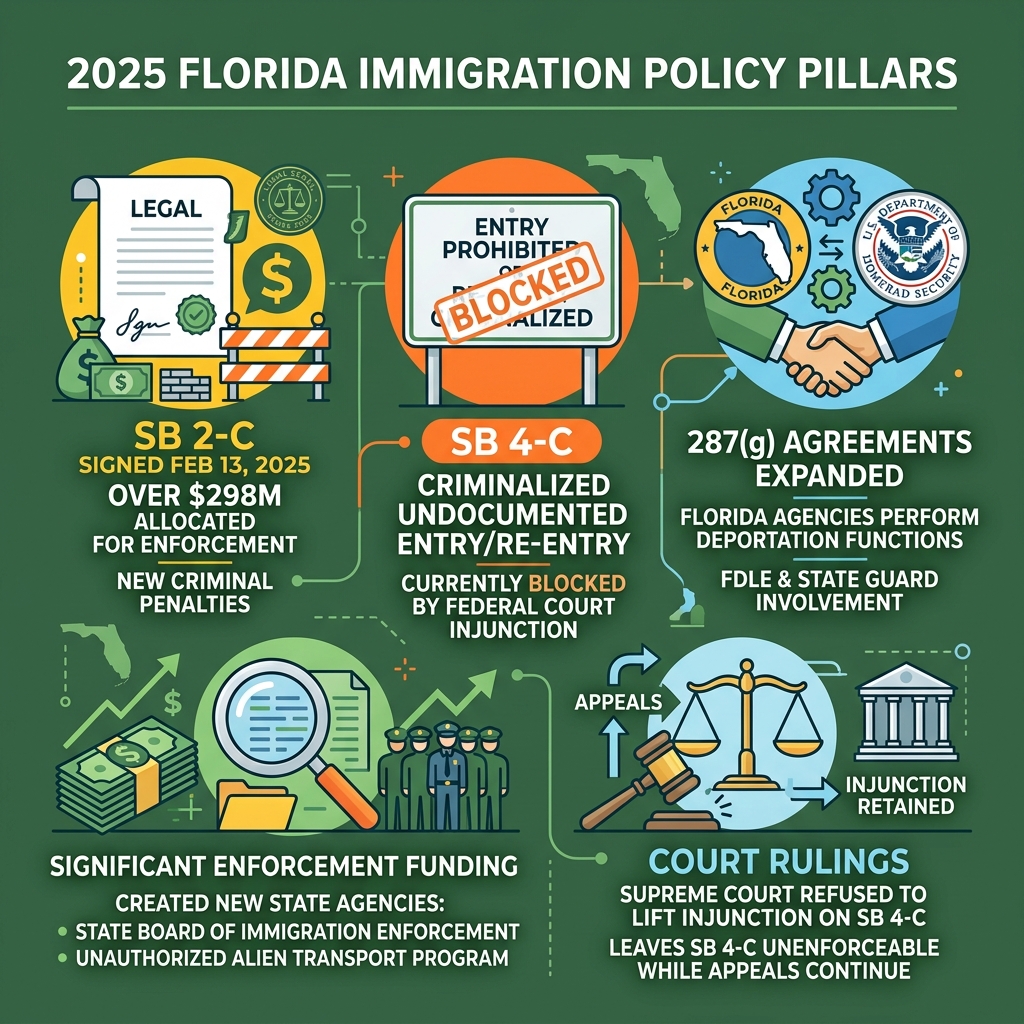
- SB 2-C signed into law in February 2025, allocating over $298 million for enforcement and creating new criminal penalties
- SB 4-C criminalized undocumented entry or re-entry into Florida — though it has faced significant federal court challenges
- The Supreme Court’s refusal to lift injunctions has left certain provisions unenforceable while appeals continue into 2026
- New state agencies operational, including the State Board of Immigration Enforcement and the Unauthorized Alien Transport Program
- 287(g) agreements expanded, giving Florida agencies like FDLE and the State Guard the power to perform federal deportation functions
- In-state tuition eliminated for undocumented students at Florida public colleges as of July 1, 2025
- Florida’s foreign-born population stands at nearly 5 million people, playing a significant role in the state’s economy and workforce
Florida isn’t standing still on immigration. Whether you support stricter enforcement or worry about the economic fallout, these changes affect everyday life in 2026 — from construction sites in Tampa to classrooms in Orlando.
The stakes are high, and the policies are moving fast. This guide breaks down exactly what changed, what’s being challenged in court, and what it all means for Florida residents today.
Florida’s New Legal Framework: Understanding SB 2-C and SB 4-C
In early 2025, the Florida Legislature moved aggressively to reshape the state’s role in border security and internal enforcement. On February 13, 2025, Governor Ron DeSantis signed two landmark pieces of legislation: Senate Bill 2-C and Senate Bill 4-C. Together, these bills represent some of the most stringent state-level immigration measures in United States history.
According to the Official record of Senate Bill 2C, this bill is a comprehensive enforcement package. It doesn’t just tweak existing rules; it creates entirely new structures for how Florida handles individuals without legal status. You can find the specific legal language in Chapter No. 2025-1 legal text, which details the state’s “Dangerous Unauthorized Alien” designation.
While SB 2-C focuses on infrastructure and funding, SB 4-C full bill text takes a more direct criminal approach. It attempts to make it a state crime for an undocumented person to simply enter or remain in Florida.
We’ve seen several new felony classifications and restrictions emerge from these bills:
- Voting Felonies: It is now a third-degree felony for a noncitizen to vote or for anyone to knowingly aid a noncitizen in voting.
- Reentry Reclassification: If an individual has been previously deported and returns to Florida, the state can reclassify the offense to a higher degree of felony.
- In-State Tuition: As of July 1, 2025, undocumented immigrants are no longer eligible for in-state tuition rates at Florida’s public colleges and universities.
- Driver License Prohibitions: The Department of Highway Safety and Motor Vehicles is strictly prohibited from issuing licenses or ID cards to unauthorized aliens.
Legal Status and the Supreme Court Ruling
The rollout of these laws hasn’t been without drama. Almost immediately after SB 4-C was signed, civil rights groups filed lawsuits. In a significant blow to the state’s immediate plans, a federal district judge in Miami, Kathleen Williams, issued a preliminary injunction blocking the enforcement of SB 4-C.
The state appealed, even taking the matter to the nation’s highest court. However, in a brief unsigned order, the Supreme Court refused to allow Florida to enforce the law while the legal battle continues. This means that as of 2026, the provision making “illegal entry” a state crime remains on hold.
The Challengers’ opposition filing argued that Florida was overstepping its bounds, violating the “dormant commerce clause” and ignoring federal preemption. This follows the precedent set in Arizona v. United States (2012), which established that the federal government, not individual states, has the primary authority over immigration enforcement. The 11th Circuit Court of Appeals continues to review the case in 2026.
Key Enforcement Provisions for Immigration in Florida 2025
While some parts of the law are tied up in court, many other provisions of immigration in Florida 2025 are moving forward full steam in 2026. We are seeing a massive shift toward a “state-led” enforcement model.
One of the most significant changes is the creation of the State Board of Immigration Enforcement. This board, housed within the Florida Department of Law Enforcement (FDLE), is designed to coordinate state and local efforts with federal authorities. Alongside it, the State Immigration Enforcement Council has been formed to provide policy oversight.
| Feature | SB 2-C | SB 4-C |
|---|---|---|
| Primary Focus | Funding & Infrastructure | Criminalization of Presence |
| Key Agency | State Board of Immigration Enforcement | Local Police/State Attorneys |
| Major Penalty | Felony for voting/aiding noncitizens | Misdemeanor for entering state |
| Status | Active / In Effect | Blocked by Court Injunction |
Another controversial pillar is the Unauthorized Alien Transport Program. Managed by the Division of Emergency Management, this program receives state funding to transport undocumented individuals to “sanctuary jurisdictions” in other parts of the country.
For those labeled as “dangerous unauthorized alien offenders,” the law now mandates strict sentencing. State attorneys are required to seek mandatory minimum prison terms for unauthorized aliens convicted of specific violent crimes or repeat entries.
Funding and Resource Allocation
Enforcement isn’t cheap. SB 2-C appropriated a staggering $298,830,552 for immigration-related activities. This isn’t just a number on a page; it translates to boots on the ground right here in the Tampa Bay area and across the state in 2026.
As noted by legal experts at Ogletree Deakins, this funding covers:
- Hiring 50 new dedicated law enforcement officers.
- $1,000 recruitment and retention bonuses for officers involved in immigration enforcement.
- Training grants for local sheriffs to partner with federal ICE agents.
- The continued operation of detention facilities, including the controversial “Alligator Alcatraz” facility in the Everglades.
Economic Contributions and Demographic Shifts
While the legal headlines focus on arrests and court orders, the data tells a story of deep economic integration. As we look at immigration in Florida 2025 and its ongoing impact in 2026, it’s impossible to ignore how much our state relies on its foreign-born population.
According to the National Conference of State Legislatures database, Florida is one of 37 states that have ramped up immigration laws recently, but our demographic profile is unique. We have the third-largest undocumented population in the country, trailing only California and Texas.
Demographic Trends for Immigration in Florida 2025
The numbers are eye-opening. As of 2026, research shows:
- Undocumented Population: An estimated 590,000 people live in Florida without legal status.
- Total Foreign-Born: Nearly 5 million Florida residents were born outside the U.S.
- Top Origins: Almost half of Florida’s immigrants come from Cuba, Haiti, Venezuela, Colombia, or Mexico.
- Integration: 89% of Florida’s immigrants speak English, and 57% are naturalized citizens.
- Education: Roughly 20% of immigrants in Florida hold a bachelor’s degree, which is nearly identical to the 22% rate among non-immigrant residents.
Workforce Contributions and Immigration in Florida 2025
The economic impact of these residents is massive. Immigrants are the backbone of several key industries that drive the Tampa Bay economy. In 2026, immigrants continue to account for:
- 47% of agricultural workers
- 41% of hotel and hospitality workers
- 35% of construction workers
- 33% of child care workers
Immigrants’ contribution to Florida’s GDP rose to 25.5% in recent years. Their share of the total workforce also grew to 27.4%. In fact, Florida’s GDP has recently grown twice as fast as the national average, a feat demographers attribute in large part to the state’s rapid population growth fueled by both international and domestic migration.
State-Federal Collaboration via 287(g) Agreements
One of the most direct ways immigration in Florida 2025 has reshaped the state in 2026 is through the expansion of the 287(g) program. This federal program allows state and local law enforcement agencies to enter into a Memorandum of Agreement (MOA) with U.S. Immigration and Customs Enforcement (ICE).
Under these agreements, state officers are trained to perform the functions of federal immigration agents. This includes:
- Administering oaths and taking evidence.
- Serving arrest warrants for immigration violations.
- Issuing immigration detainers to hold individuals in jail for ICE pickup.
- Transporting detainees to federal facilities.
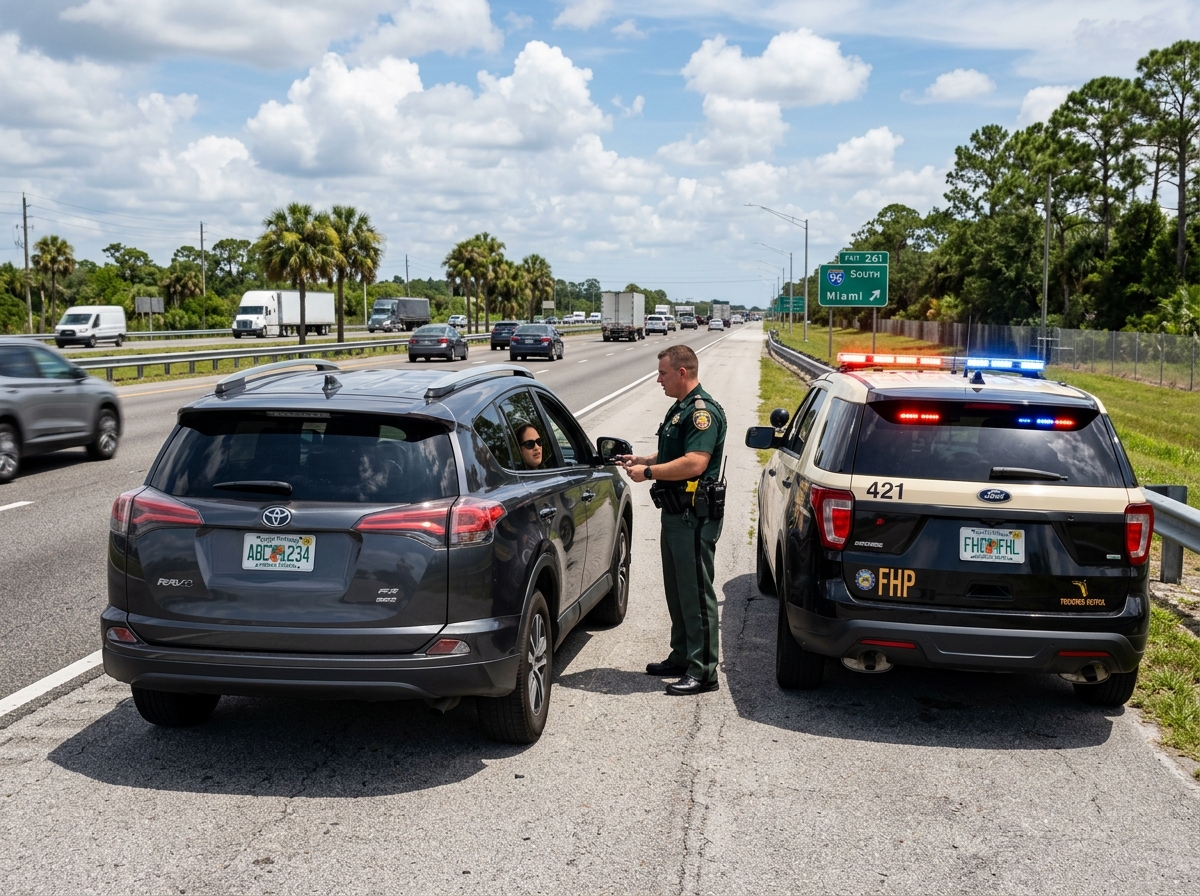
Governor DeSantis recently announced additional agreements involving the FDLE, the Florida Fish and Wildlife Conservation Commission (FWC), and the Florida State Guard. The Florida Highway Patrol has also been a key player in these efforts.
The ICE 287(g) program details explain that this partnership is intended to identify and remove “criminal aliens” from the community. However, critics and some law enforcement leaders have raised concerns that these aggressive efforts can scare people away from calling 911 during emergencies. We believe in the rule of law, and these partnerships are a core part of the state’s strategy to work alongside national enforcement goals in 2026.
Frequently Asked Questions about Florida Immigration
What are the penalties for undocumented entry under SB 4-C?
Under the text of SB 4-C, entering Florida without legal status is classified as a first-degree misdemeanor for adults, carrying a minimum penalty of nine months in jail. However, it is important to remember that this specific provision is currently blocked by a federal court and cannot be enforced in 2026 while the injunction remains in place.
Can undocumented immigrants receive in-state tuition in 2026?
No. Effective July 1, 2025, Florida eliminated in-state tuition eligibility for undocumented students at all public colleges and universities. These students are now required to pay out-of-state rates, which are significantly higher.
How does Florida’s 287(g) program work with federal authorities?
The program allows Florida state and local officers to act as an extension of ICE. After receiving specialized training, these officers can check the immigration status of people in local jails, issue detainers, and assist in the deportation process. This collaboration is designed to ensure that undocumented individuals who encounter the justice system are funneled directly into federal custody.
Conclusion
The landscape of immigration in Florida 2025 has evolved into a complex reality for 2026. From the halls of the State Capitol to the courtrooms of the Supreme Court, the battle over who can live, work, and stay in the Sunshine State is more intense than ever.
At the Shay Williams Campaign, we understand that these issues aren’t just about statistics; they are about the safety of our neighborhoods and the strength of our economy. Shay Williams is fighting for a balanced approach that supports our law enforcement, ensures the rule of law, and keeps Florida’s economy growing. As a candidate for U.S. Congress in Florida’s 14th District, Shay is dedicated to representing the unique needs of the Tampa Bay area in this national conversation.
We must secure our borders and reform our system so that it works for all Floridians. For more updates on how we are advocating for you in Washington and at home, visit More info about Shay Williams’ work for you.
Together, we can ensure that Florida remains a place of opportunity, safety, and growth for every resident in 2026.