Putting America First on the Global Stage
What Is America First Foreign Policy?
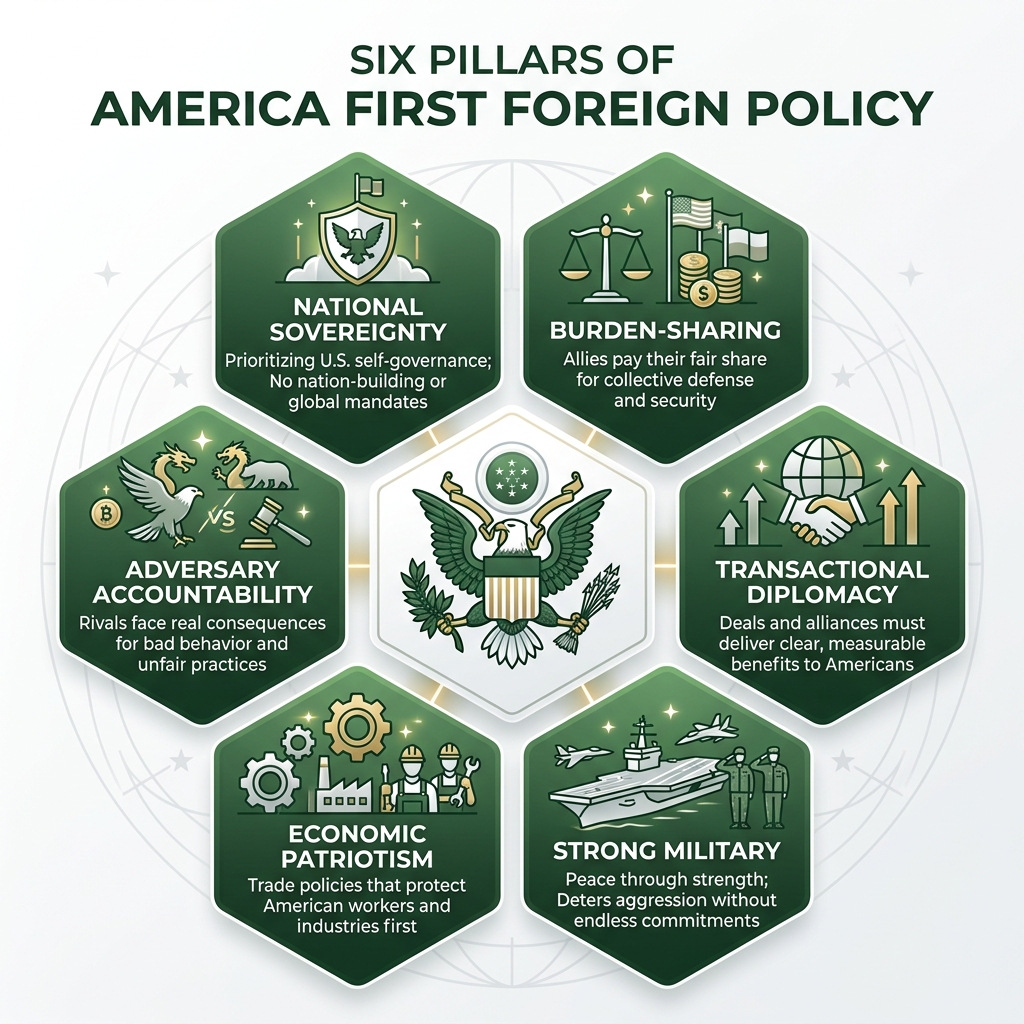
America First foreign policy is the governing principle that the United States should prioritize the safety, prosperity, and well-being of its own citizens above all else when making decisions on the world stage.
Here is a quick breakdown of what it means in practice:
| Core Idea | What It Means |
|---|---|
| National Sovereignty | Every nation has the right to govern itself; the U.S. will not impose its will through nation-building |
| Burden-Sharing | Allies must pay their fair share of collective defense costs |
| Transactional Diplomacy | Deals and alliances must deliver clear, measurable benefits to Americans |
| Strong Military | Peace comes from strength, not from endless overseas commitments |
| Economic Patriotism | Trade policy should protect American workers and industries first |
| Adversary Accountability | Rivals like China, Iran, and others face real consequences for bad behavior |
This approach does not mean isolationism. As supporters put it, “America First does not mean America alone.” It means engaging with the world on American terms, not through multilateral institutions that may not serve U.S. interests.
The policy has roots going back more than a century, but its modern form was shaped by Donald Trump’s 2016 campaign and two presidential terms. It represents a sharp break from the post-Cold War model of liberal internationalism, which prioritized global institutions and open-ended military commitments.
I’m Shay Williams, a retired U.S. Coast Guard Commander with over 30 years of service in counter-narcotics operations, search and rescue, and national security missions — experience that gives me a ground-level understanding of how america first foreign policy plays out in the real world. As a candidate for Congress in Florida’s 14th District, I believe this approach is exactly what American families need right now.
The Evolution and Definition of America First Foreign Policy
To understand where we are today, we have to look at where we started. The term “America First” isn’t a modern invention; it’s a deeply rooted American tradition that prioritizes national identity and protectionism over global entanglements. In the 19th century, this often manifested as nativism, focusing on building our own strength at home before looking across the oceans.
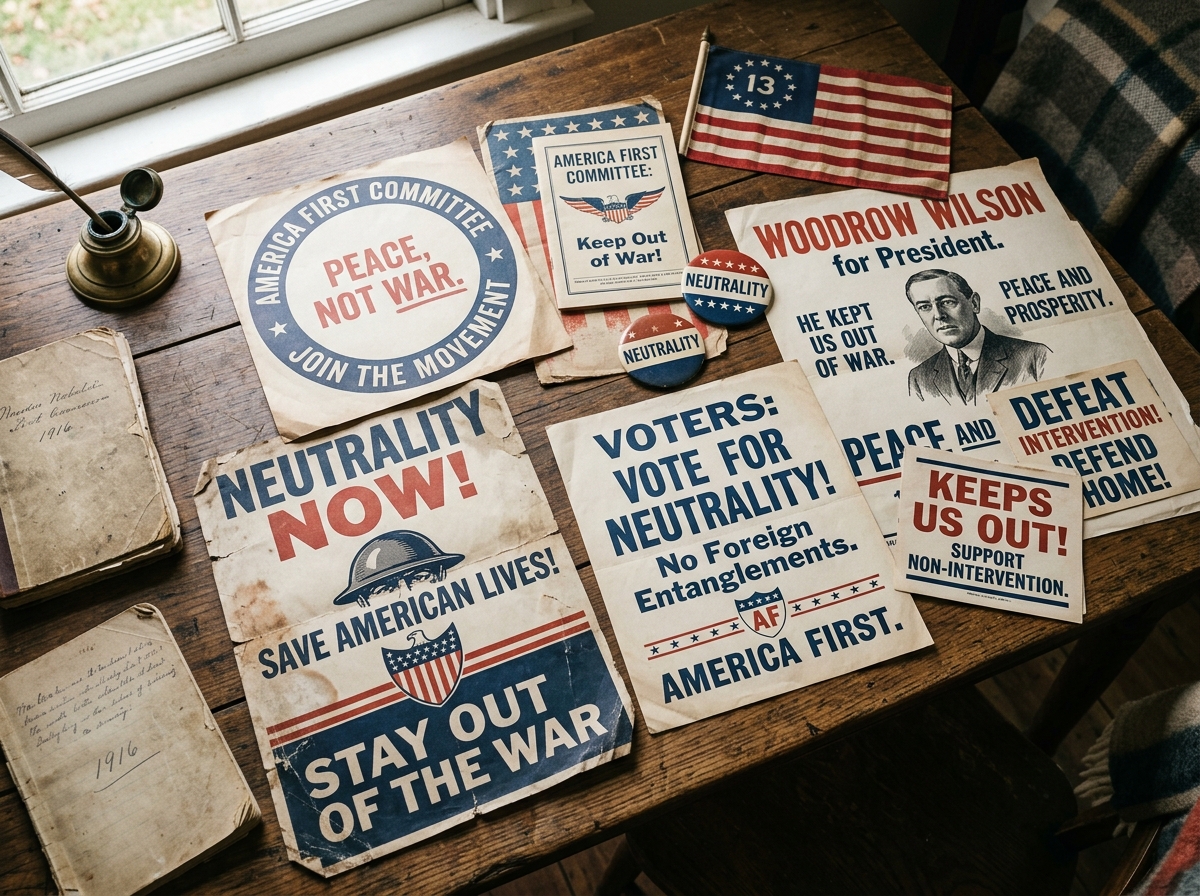
The slogan gained massive political weight during the 20th century. Woodrow Wilson used it in 1916 to emphasize neutrality as the world descended into World War I. Later, Warren G. Harding leaned into it during his 1920 campaign, promising a “return to normalcy” after the chaos of war. However, the most famous historical iteration was the America First Committee, a non-interventionist group that fought tooth and nail to keep the U.S. out of World War II. While that movement eventually dissolved after the attack on Pearl Harbor, the sentiment remained a quiet but powerful force in American politics, occasionally resurfacing with figures like Pat Buchanan in the 1990s.
Historical Origins from Wilson to Lindbergh
The history of america first foreign policy is often tied to the concept of neutrality. Figures like Charles Lindbergh became the face of the non-interventionist movement, arguing that America should be a “fortress” rather than a global policeman. This era was marked by a sharp debate over our role in the world.
Critics at the time, including the famous author Dr. Seuss, used political cartoons to satirize these views, often suggesting that ignoring global threats would eventually bring the fight to our doorstep.
Defining the Modern America First Foreign Policy
Fast forward to the 21st century, and we see a refined version of this doctrine. Modern america first foreign policy is less about hiding from the world and more about Establishing an America First Foreign Policy that uses transactional diplomacy.
We aren’t looking to retreat; we are looking for better deals. This means economic patriotism—ensuring our trade deals don’t hollow out our middle class—and strict border security, recognizing that a nation without a border isn’t a nation at all. It’s about being “pragmatic without being pragmatist,” as some analysts have noted, focusing on what actually works for the American worker.
Core Principles: Principled Realism and Sovereignty
At the heart of this movement is “Principled Realism.” This isn’t about lofty, unattainable ideals; it’s about seeing the world as it is, not how we wish it would be. For decades, the U.S. followed a path of liberal internationalism, often subordinating our interests to global bodies. We believe it’s time to flip that script.
| Feature | Liberal Internationalism | America First |
|---|---|---|
| Focus | Global Institutions (UN, WHO) | National Sovereignty |
| Military | Nation-building & Intervention | Deterrence & Vital Interests |
| Trade | Multilateral Free Trade | Bilateral Reciprocal Deals |
| Alliances | Open-ended Commitments | Burden-sharing & Fair Play |
Our National Security Strategy (NSS) documents, particularly the 2017 version, made this clear: we prioritize American interests first. This includes ending “forever wars” that drain our resources and cost American lives without a clear path to victory.
Principled Realism in Practice
In practice, this means respecting the sovereignty of other nations while demanding they respect ours. When we speak at the UN General Assembly, we aren’t asking for permission to lead; we are inviting other sovereign nations to join us in shared global responsibilities.
Peace through strength is the goal. By maintaining a military that is too powerful to challenge, we deter conflict before it starts. This isn’t about being a bully; it’s about being the adult in the room who ensures that National Security Strategy of the United States of America remains focused on the safety of our homes here in places like Tampa and St. Petersburg.
Ending Nation-Building and Forever Wars
One of the biggest shifts in america first foreign policy is the rejection of nation-building. We’ve seen the results of trying to export democracy at the point of a bayonet—it rarely works and costs far too much.
The Doha Agreement was a major step in this direction, aiming to bring our troops home from Afghanistan after twenty years. We believe military force is not a way to demonstrate power and resolve for its own sake, but a tool to be used judiciously to protect our vital interests. By focusing on counterterrorism rather than social engineering abroad, we keep our focus where it belongs.
Strategic Implementation: Alliances and Adversaries
When it comes to our friends and our foes, america first foreign policy is clear: we expect our partners to step up, and we expect our rivals to back down.
For too long, the U.S. carried the lion’s share of the burden for global security. In 2017, only 5 out of 28 NATO members were meeting their 2% GDP defense spending commitment. We changed that conversation. By 2025, 16 allies announced increases, with pressure now mounting to reach 5% of GDP for those who rely most heavily on our protection. This is about preventing the emergence of challengers and preserving US dominance through fair play.
Reforming NATO and Global Burden-Sharing
We believe in NATO, but we believe in a NATO where everyone pays their tab. The Wales Declaration was a start, but we pushed for more. We also recognized that European energy independence is a national security issue for us.
By sanctioning projects like Nord Stream 2, we aimed to prevent our allies from becoming dependent on Russian gas, which only weakens the alliance. It’s a tough-love approach that acknowledges NATO Survives Trump but the Turmoil Is Leaving Scars, but ultimately makes the partnership more resilient and honest.
Confronting Adversaries under an America First Foreign Policy
Our adversaries have learned that the days of “leading from behind” are over. We’ve implemented a maximum pressure campaign against Iran, Sanctioning Iran’s Oil Exports to drive their ability to fund terror to zero.
With China, we’ve taken a stand against intellectual property theft and unfair trade through targeted tariffs. We’ve also prioritized the fentanyl crisis, linking trade relief to interdiction efforts with our neighbors. This isn’t just “foreign” policy; it’s local policy. When we stop fentanyl at the source, we save lives in the Tampa Bay area.
Measurable Results and Future Implications
The results of this shift are not just rhetorical; they are measurable. Under an america first foreign policy, we saw the total collapse of the ISIS “caliphate” in Iraq and Syria. In just the first six months of the Trump administration, ISIS lost one-third of its territory, leading to the full liberation of Mosul.
We also took a hard look at where our tax dollars go. We oversaw an 85% cut to USAID programs that didn’t align with our interests, terminating over $80 billion in inconsistent foreign assistance. Meanwhile, we secured over $1 trillion in investment commitments from partners like the UAE and Saudi Arabia in defense, energy, and tech. That’s what we call a win for the American taxpayer. These are the kinds of 100 Days of an America First State Department results that prove the doctrine works.
Economic Achievements and Trade Deals
Trade is where the “First” in America First really shines. We withdrew from the TPP because it didn’t favor our workers. Instead, we pushed for reciprocal trade.
Our trade missions have been incredibly successful, such as the delegation to Iraq that resulted in $30 billion in agreements. By advocating for U.S. companies, we’ve helped secure over $64 billion in new deals globally. For us in Florida, this means more jobs and a stronger local economy as our port and tech sectors find new markets.
Criticisms and Risks of an America First Foreign Policy
Of course, not everyone is a fan. Critics from places like Brookings often argue that “America First” is actually “America Alone” or even Trump’s “America First” is America the Small. They worry that by stepping back from multilateralism, we lose our diplomatic credibility and risk global stability.
We disagree. We believe that by being clear about our interests, we actually create more stability. Allies know exactly where we stand, and adversaries know exactly what will happen if they cross the line. The risk isn’t in being strong; the risk is in being vague and overextended.
Frequently Asked Questions about America First
What is the core definition of America First foreign policy?
At its heart, it is a citizen-centric approach. It means that The Meaning of ‘America First’ Foreign Policy is rooted in the idea that our government’s primary moral obligation is to the people who pay the taxes and vote in our elections. It prioritizes sovereignty, realism, and national interest over globalist agendas.
Does America First mean the U.S. is becoming isolationist?
Absolutely not. Isolationism means hiding from the world. America First foreign policy means engaging the world aggressively to get the best deals for our people. It’s about America First Does Not Mean America Alone—we still have strategic alliances, but they are based on mutual benefit and transactional reality rather than blind tradition.
How does this policy affect U.S. participation in NATO?
It modernizes it. We remain a key part of the alliance, but we demand that our partners meet their financial obligations. When Trump says he threatened not to defend NATO against Russia, it was a call to action for our allies to take their own defense seriously. Since then, we’ve seen a massive shift in European defense spending, making the whole world safer.
Conclusion
The Shay Williams Campaign is built on the belief that Florida’s 14th District deserves a representative who understands that our strength abroad starts with our strength at home. By focusing on economic growth, supporting our law enforcement, and securing our borders, we create a foundation for an america first foreign policy that truly delivers.
We don’t need more “forever wars” or trade deals that ship our jobs overseas. We need peace through strength and a government that remembers who it works for. If you believe in an America that is independent, secure, and prosperous, we invite you to Support the America First Agenda and join us in this fight. Together, we can ensure that the United States remains the “last, best hope” for ourselves and the world.