How Supply Side Policies Can Fix a Sluggish Economy
Why Supply-Side Policies Matter for a Sluggish Economy
Supply-side policies are government strategies designed to increase the productive capacity of an economy — boosting output, efficiency, and long-term growth from the ground up.
Here’s a quick breakdown of what they involve:
- What they are: Policies that improve how efficiently businesses and markets produce goods and services
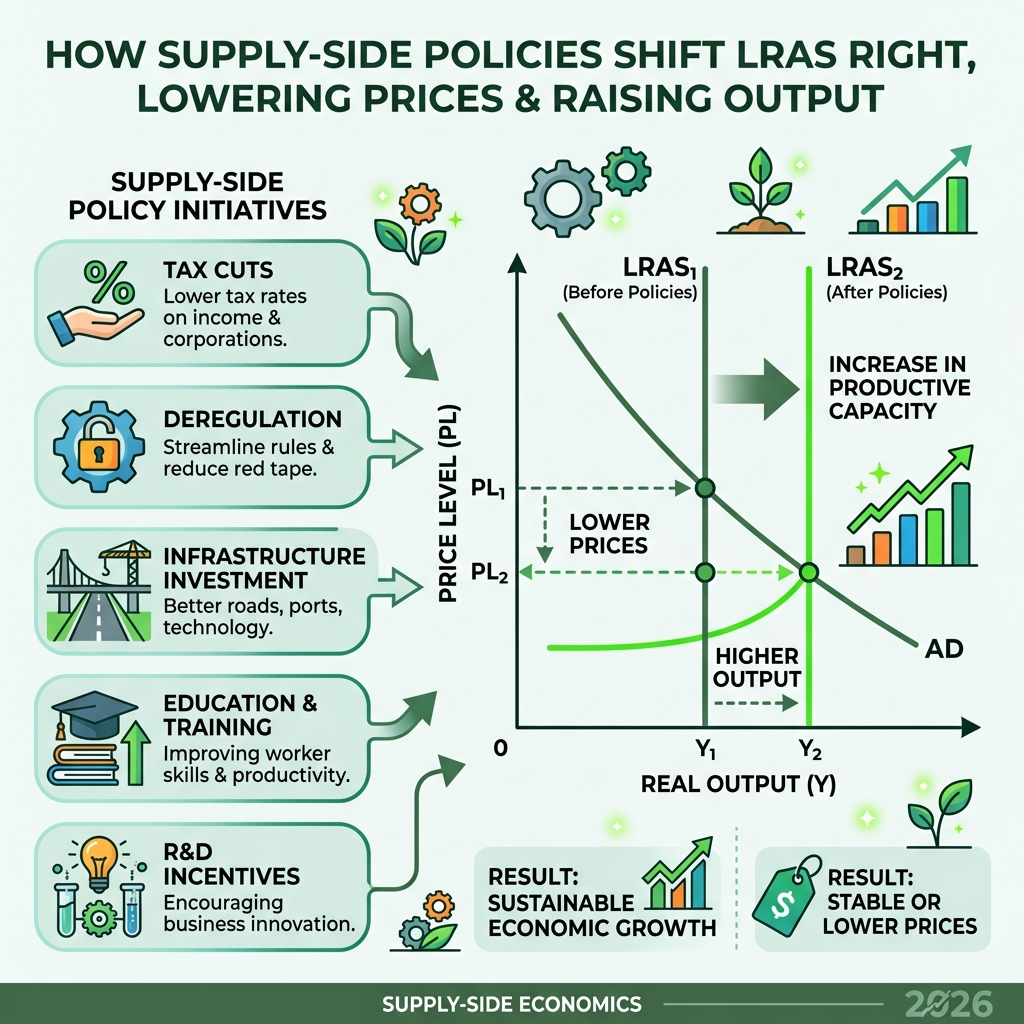
- How they work: By shifting the Long-Run Aggregate Supply (LRAS) curve to the right — meaning more output at stable or lower prices
- Key tools: Tax cuts, deregulation, privatization, infrastructure investment, and education spending
- Main goal: Sustainable economic growth without triggering inflation
- Who benefits: Businesses, workers, and consumers — through more jobs, lower prices, and higher wages
When an economy stalls — growth slows, wages flatline, and businesses stop investing — demand-side stimulus alone often isn’t enough. Real, lasting recovery requires fixing the supply side. That means removing barriers to production, rewarding work and investment, and building the infrastructure that makes businesses competitive.
As economist Arthur Laffer famously argued, tax rates set too high can actually reduce government revenue by discouraging productive activity. Getting the balance right is what supply-side economics is all about.
I’m Shay Williams — a retired U.S. Coast Guard Commander who spent over 30 years managing resources, cutting inefficiencies, and delivering results in high-stakes environments. That same discipline shapes how I look at supply-side policies and what it takes to build a stronger economy for Tampa Bay families. Let’s break down exactly how these strategies work and why they matter right now.
Understanding supply-side policies vs. Demand-Side Economics
To understand how we can fix our local economy here in Tampa, we first have to distinguish between the two heavyweights of economic thought: supply-side and demand-side. Think of the economy as a high-performance vehicle. Demand-side economics is like stepping on the gas pedal to use the fuel you already have. Supply-side policies, on the other hand, are about upgrading the engine so the car can go faster and further without overheating.
Demand-side economics, often associated with Keynesian theory, focuses on consumers. The idea is that if the government puts money into the hands of shoppers—through stimulus checks or public works projects—those people will spend it, creating demand that forces businesses to hire.
In contrast, supply-side policies focus on the producers. We believe that by making it easier and cheaper to produce goods and services, we create a “trickle-down” effect of wealth and opportunity. When a business in the Tampa Bay area saves money on taxes or spends less on red tape, they don’t just sit on that cash; they invest in new equipment, hire more neighbors, and expand their operations.
| Feature | Supply-Side Economics | Demand-Side Economics |
|---|---|---|
| Primary Focus | Producers and Suppliers | Consumers and Shoppers |
| Main Goal | Increase productive capacity (LRAS) | Increase total spending (Aggregate Demand) |
| Key Tools | Tax cuts for businesses, deregulation | Stimulus checks, government spending |
| Inflation View | Helps reduce inflation by increasing supply | Can risk inflation by overstimulating demand |
| Long-Term Effect | Sustainable, non-inflationary growth | Short-term boost to spending |
Shifting the LRAS Curve with supply-side policies
In technical terms, our goal is to shift the Long-Run Aggregate Supply (LRAS) curve to the right. This represents the total amount of goods and services an economy can produce when it’s firing on all cylinders—what we call “potential output.”
When we implement supply-side policies, we are targeting full employment and efficiency gains. By lowering production costs, we allow the economy to grow without the “cost-push” inflation that hurts families at the grocery store. If a manufacturer in Tampa can produce more widgets at a lower cost because of a tax break or a more flexible labor market, the entire community wins.
Overlap with Demand-Side Strategies
It is a mistake to think these two theories never talk to each other. In the real world, there is often a significant overlap. For example, when the government invests in a major public works project—like improving the port or highways in the Tampa Bay area—it creates an immediate demand for construction workers (demand-side). However, once those roads are built, they lower the cost of transporting goods for every business in Florida (supply-side).
Similarly, tax reductions can serve both sides. A cut in the personal income tax gives families more money to spend (demand-side) but also increases the incentive for a person to work extra hours or seek a promotion because they get to keep more of their hard-earned paycheck (supply-side). Our focus is on ensuring these policies create lasting, long-term equilibrium rather than just a temporary “sugar high” of spending.
Market-Based vs. Interventionist Strategies
Not all supply-side policies look the same. They generally fall into two categories: market-based and interventionist. As Republicans, we often lean toward market-based solutions because we trust the ingenuity of our local entrepreneurs more than a bureaucrat’s spreadsheet. However, smart infrastructure is also a key piece of the puzzle.

Market-Based supply-side policies: Tax Cuts and Incentives
Market-based strategies are all about removing the “speed bumps” that the government puts in the way of progress. We want to increase competition and market efficiency by getting the government out of the way.
Key market-based reforms include:
- Income Tax Cuts: Increasing work incentives so that people in Tampa feel it’s worth their while to work harder.
- Corporation Tax Reductions: Lowering the rate (historically seen in moves like the UK’s drop from 20% toward 17%) to stimulate domestic investment and attract Foreign Direct Investment (FDI).
- Deregulation: Cutting the “red tape” that forces small business owners to spend more time on paperwork than on their customers.
- Privatization: Selling off state-owned assets to private companies that have a profit motive to be efficient and innovative.
- Capital Gains Reform: Encouraging investment in the stock market and new ventures by letting investors keep more of their returns.
By reducing the “taper rate” at which benefits are taken away—for instance, from 65% to 63%—we ensure that work always pays more than staying home. This is vital for maintaining a healthy, motivated workforce in Florida’s 14th District.
Interventionist supply-side policies: Infrastructure and Education
While we want a smaller government, we recognize that the government has a role in fixing “market failures”—areas where the private sector might not invest enough on its own. These are interventionist supply-side policies.
- Human Capital: This is just a fancy way of saying “education and training.” By investing in vocational schools and STEM programs in Tampa, we ensure our workers have the skills needed for 21st-century jobs.
- R&D (Research and Development): Government subsidies or tax credits for innovation help companies develop the next big technology right here in Florida.
- Infrastructure: Whether it’s a £2.3 billion Housing Infrastructure Fund or a £400 million investment in “full-fiber” super-fast broadband, these projects lower the “friction” of doing business.
- Healthcare: A healthy workforce is a productive workforce. Policies that improve access to care without breaking the bank help keep our economy moving.
The Laffer Curve and Real-World Applications
One of the most famous concepts in our toolkit is the Laffer Curve. Named after Arthur Laffer, it illustrates a simple truth: there is a point where tax rates become so high that they actually discourage people from working or investing, which leads to less total tax revenue for the government.
When tax rates are at 0%, the government gets $0. When they are at 100%, the government also gets $0 because nobody is going to work for free! Somewhere in the middle is the “revenue-maximizing” rate. Many economists believe that for top earners, that rate is around 70%, but we argue that keeping rates much lower stimulates enough growth to make up for the lower percentage.
Impact on Growth, Employment, and Inflation
When supply-side policies work, the results are beautiful. We see:
- Productivity Gains: Workers produce more per hour, which leads to higher wages.
- Job Creation: As businesses expand, the natural rate of unemployment drops.
- Lower Inflation: Because we are increasing the supply of goods, prices tend to stay stable even as the economy grows. This is the best way to fight inflation—not by making people poorer so they buy less, but by making goods more plentiful so they cost less.
Historical examples like “Reaganomics” in the 1980s showed how massive tax cuts ($749 billion over five years) could help pull an economy out of stagflation. Even earlier, in the 1920s, cutting the top tax bracket from over 70% to less than 25% actually saw tax revenues increase significantly because the economy boomed so much.
Criticisms and Equity Concerns
We have to be honest: not every supply-side experiment has been a home run. Critics often point to “trickle-down theory” and express concerns about wealth inequality. They argue that tax cuts for the wealthy don’t always reach the average worker.
There is also the issue of “time lags.” Unlike a stimulus check that hits a bank account in a week, a supply-side policy like an education reform might take 10 or 20 years to show results. Furthermore, if tax cuts aren’t met with spending restraint, they can lead to budget deficits.
A famous example of a struggle was The Kansas tax cut experiment under Governor Sam Brownback. In that case, the state saw a $231 million revenue loss in the first year, and the economy grew about 7.8% less than it would have otherwise. This teaches us that supply-side policies must be implemented carefully, with an eye on the specific needs of the local community and a balanced budget. We use “dynamic scoring” to try and predict these outcomes, but we must always remain grounded in reality.
Frequently Asked Questions about Supply-Side Policies
Do supply-side tax cuts pay for themselves?
This is the “million-dollar question.” The answer is: sometimes, but not always. In the 1920s, they absolutely did. However, the Revenue Act of 1964 reduced tax revenue by about $12 billion, and while growth recaptured about $3 to $9 billion of that, it didn’t cover the whole bill. Most CBO estimates suggest that modern tax cuts recoup about one-third of their cost through increased economic expansion. The goal isn’t just “free money”; it’s about creating a healthier, more vibrant economy where everyone has a chance to succeed.
How do supply-side policies reduce inflation?
Inflation happens when there is too much money chasing too few goods. Demand-side fixes usually involve making people spend less (which is painful). Supply-side fixes involve making more goods. By increasing efficiency and lowering production costs, we shift the aggregate supply. When there are more houses, more food, and more services available, the price levels naturally stabilize. It’s about market flexibility.
What are the main risks of supply-side reform?
The biggest risk is the “time lag.” It takes time to build a bridge or train a new generation of nurses. There is also the risk of “market failure” if deregulation goes too far and leads to monopolies. Finally, if we aren’t careful, we can see an increase in government debt if the growth doesn’t happen as fast as we projected. That’s why we need experienced leaders who know how to manage resources responsibly.
Conclusion
Economic prosperity isn’t an accident; it’s the result of deliberate, smart choices. Here in the Tampa Bay area, we have the talent, the location, and the drive to lead the nation. By implementing sound supply-side policies, we can unlock the full potential of Florida’s 14th District.
As your candidate for U.S. Congress, I am committed to fighting for the economic growth that our families deserve. We need to support our law enforcement, secure our borders, and ensure Republican control of the House to bring back fiscal sanity. I’ve spent my life working for you in the Coast Guard, and I’m ready to do the same in Washington. Let’s build an economy that works for everyone—from the small business owner in Tampa to the worker looking for their next big opportunity. Together, we can make our engine run better than ever before.