
Who is Actually in Charge of the House?
Who Actually Controls the House Right Now?
The GOP house majority is razor-thin — and it’s shaping every vote, every policy, and every political fight in Washington right now.
Here’s the quick breakdown of where things stand:
| Party | Seats |
|---|---|
| Republicans | 217-218 |
| Democrats | 213-214 |
| Independent | 1 |
| Vacancies | 3-4 |
| Total | 435 |
Key facts at a glance:
- Republicans need 218 seats to control the House
- Speaker Mike Johnson can afford to lose only one Republican vote on any party-line bill
- This is the slimmest House majority since the 1930s
- Three seats are currently vacant due to a resignation, a death, and another departure
- Republicans also control the Senate 53-47, giving the GOP full control of Congress
That one-vote margin sounds small — because it is. It means a single member calling in sick, missing a flight, or voting “no” out of principle can sink an entire piece of legislation.
I’m Shay Williams, a retired U.S. Coast Guard Commander who spent over 30 years leading teams in high-stakes, zero-margin-for-error environments — the kind of leadership the GOP house majority desperately needs right now. As a candidate for Florida’s 14th District, I know what it takes to make every vote count when the stakes are this high.
The Current State of the GOP House Majority
When we talk about who is “in charge” of the House of Representatives, we are talking about a numbers game that is played out every single day on the House floor. Currently, the Republican Party holds the gavel, but the margin of error is so small it’s practically invisible.
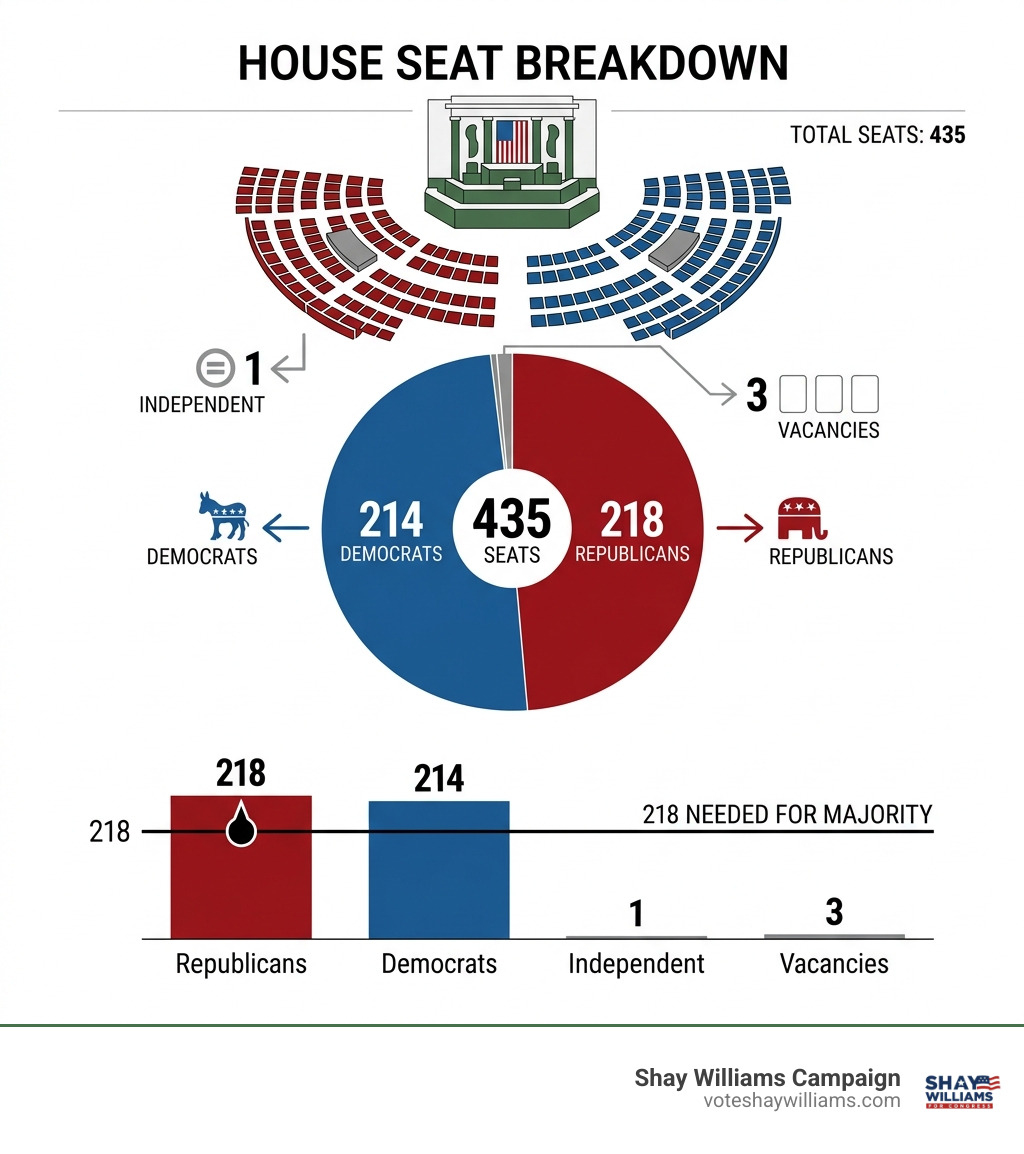
As of early 2026, the Republican conference holds 218 seats, while Democrats hold 214. There are currently 3 vacancies in the 435-seat chamber. To pass most legislation, a simple majority of those present and voting is required. If everyone shows up, that magic number is 218.

According to the Official Party Breakdown, the balance of power is a constant seesaw. Because the GOP house majority is so tight, Speaker Mike Johnson often finds himself in a position where he can only afford to lose a single Republican vote on any given issue. If two Republicans defect or simply miss the vote due to a delayed flight, the GOP loses control of the floor.
To give you a better idea of how this looks across the entire Capitol, here is how the House compares to the Senate:
| Chamber | Republican Seats | Democratic/Independent Seats | Vacancies |
|---|---|---|---|
| U.S. House | 218 | 214 | 3 |
| U.S. Senate | 53 | 47 | 0 |
While the Senate enjoys a more comfortable Republican majority, the House is a different story entirely. Every single member of the GOP conference effectively holds veto power over the party’s agenda.
Understanding the GOP House Majority Composition
The 119th Congress, which convened in January 2025, is defined by this mathematical tension. The House is comprised of 435 voting members, a number that has been capped since 1929. Representation is based on population, which is why states like California have dozens of representatives while others have only one.
In addition to the voting members, there are non-voting delegates from territories like Puerto Rico and Washington, D.C. While these delegates can participate in debates and vote in committees, they cannot vote on the final passage of bills on the House floor. This means the 119th United States Congress Overview shows that the burden of governing rests entirely on the shoulders of the 435 voting representatives.
For Republicans, maintaining 218 votes is the daily “North Star.” Without it, the “majority” is a majority in name only. This is why leadership spends so much time counting heads and checking schedules.
Maintaining the GOP House Majority Amid Vacancies
Vacancies are the silent killers of a slim majority. When a member resigns or passes away, that seat remains empty until a special election can be held. This lowers the total number of members, but it also shrinks the GOP’s “cushion.”
Recent events have hit the GOP house majority hard. The resignation of Marjorie Taylor Greene (R-GA) and the passing of Rep. Doug LaMalfa (R-CA) removed two reliable Republican votes from the board. On the other side, the resignation of Mikie Sherrill (D-NJ) also affected the Democratic count.
When these vacancies occur, the “math” of the House changes. If the total number of voting members drops to 432, the number of votes needed to pass a bill might drop to 217, but the GOP’s ability to withstand internal defections remains just as precarious. This is why understanding the Florida 14th District Election Breakdown is so important—every seat, especially those in competitive areas like Tampa Bay, is vital to the national balance of power.
Leadership and the Strategy of a One-Vote Margin
Governing with a one-vote margin isn’t just difficult; it’s a logistical marathon. The people responsible for keeping the wheels on the wagon are the House GOP leaders.
At the top is Speaker Mike Johnson, who has the unenviable task of uniting a diverse group of Republicans ranging from moderates in “blue” districts to hardline conservatives. Assisting him is Majority Leader Steve Scalise, the second-highest-ranking Republican, who manages the legislative calendar. Then there is Majority Whip Tom Emmer, whose entire job is “whipping” up the votes—essentially counting, cajoling, and convincing members to stay in line.
The House Republican Conference serves as the primary hub for these efforts. They produce a daily “Legislative Digest” that helps members understand exactly what they are voting on and why it matters to the party’s broader message.
Key Priorities for GOP Leadership
Despite the narrow margins, the GOP house majority has been aggressive in pushing its core agenda. Leadership, including Steve Scalise, has been vocal about several “must-pass” priorities:
- DHS Funding and Border Security: A major point of contention has been fully funding the Department of Homeland Security while implementing stricter border controls. Republicans have criticized Democrats for failing to support these measures, arguing that American safety is at risk.
- Tax Cut Extensions: With many of the 2017 tax cuts set to expire, Republicans are focused on extending these provisions to spur economic growth.
- The Laken Riley Act: This legislation, aimed at strengthening immigration enforcement, has been a key messaging point for the conference.
- Oversight and Investigations: With committee chairs like Jim Jordan (Judiciary) and James Comer (Oversight), the GOP is using its majority to investigate the executive branch and provide a check on the Biden-Harris-Schumer agenda.
Managing Attendance and Health Risks
In a one-vote majority, attendance is quite literally a matter of life and death for legislation. GOP leaders have become experts on rural airport flight schedules, weather patterns, and the personal health of their members.
We see leadership tracking members minute-by-minute. If a member like Neal Dunn or Tony Gonzales has a health scare or a family emergency, the entire legislative schedule might have to be paused. Speaker Johnson has even half-jokingly told his members to “take your vitamins” and avoid “adventure sports” to ensure they stay healthy and available for floor votes.
There are strict attendance mandates. Unless it is a dire emergency, members are expected to be in D.C. when the bells ring for a vote. This “all hands on deck” mentality is the only way the GOP house majority can function.
Challenges to Governing with a Slim Majority
The reality of a one-vote margin is that “chaos” is often just one person away. When the majority is this small, any single member—or a small group of “hardliners”—gains immense leverage. They can demand changes to a bill in exchange for their “yes” vote, knowing that without them, the bill fails.
This leads to procedural losses where the GOP might actually lose control of the “rule” (the debate parameters for a bill), effectively ceding the floor to Democrats. It’s a high-stakes game of poker where the minority party is always looking for a way to exploit GOP divisions. For a deeper look at these dynamics, you can read more about the Inside the Chaotic House GOP Majority.
Historical Context of Narrow Margins
While it feels unprecedented, we have seen slim majorities before—though you have to go back quite a way to find one this tight. This is the slimmest margin since the 72nd Congress in 1931, a pre-World War II era where the country was grappling with the Great Depression.
Historically, majorities have usually been more robust. For example, the 1994 “Republican Revolution” led by Newt Gingrich gave the GOP a much more comfortable cushion to pass the “Contract with America.” Even the Democratic majority in 2021, which was considered narrow at the time with a four-seat margin, looks like a “landslide” compared to what Speaker Johnson is working with today.
Personal Sacrifices and Voting Logistics
The stories of what members do to make it to a vote are often dramatic. We have seen members fly across the country against doctor’s orders following heart surgery just to cast a single vote. Others have delayed funerals for family members or returned to the Capitol just days after a personal tragedy to ensure the GOP house majority didn’t crumble on a key spending bill.
Because proxy voting (voting on behalf of an absent member) has been banned in the current Congress, physical presence is mandatory. This means members have to navigate travel hurdles, car accidents, and sudden illnesses with almost superhuman resilience. The “whip” operation isn’t just about policy; it’s about logistics, emotional support, and sometimes, a bit of tough love to get members to the floor.
Frequently Asked Questions about the GOP House Majority
How many seats do Republicans currently hold in the House?
As of the most recent counts in the 119th Congress, Republicans hold 218 seats, while Democrats hold 214. There are 3 vacancies and 1 Independent member. Because 218 is the number required for a majority in a full 435-member House, the GOP is at the absolute minimum threshold for control.
Who are the primary leaders of the House Republican Conference?
The leadership team is headed by Speaker Mike Johnson (LA). He is supported by Majority Leader Steve Scalise (LA), Majority Whip Tom Emmer (MN), and Conference Chair Lisa McClain (MI). Together, they coordinate the party’s legislative strategy and floor operations.
Why is the GOP majority considered “historically slim”?
It is considered historically slim because it allows for virtually zero defections. With a one-vote margin, the GOP is in its most precarious position since 1931. This makes governing highly dependent on perfect attendance and total party unity, neither of which is easy to achieve in modern politics.
Conclusion
The GOP house majority is a testament to the importance of every single seat in Congress. When one vote can determine the direction of the country, the leadership we send to Washington matters more than ever.
As we look toward the future, the focus remains on economic growth, meaningful immigration reform, and supporting our law enforcement. These aren’t just talking points; they are the priorities that a stable Republican majority can deliver for the American people.
We are fighting to ensure that Florida’s 14th District has a voice that understands high-stakes leadership. Whether it’s managing a razor-thin vote in the House or leading a Coast Guard mission in the Gulf, the principles are the same: stay focused, stay disciplined, and make every count matter.
For More info about Shay Williams for Congress, join us as we work to strengthen the Republican trifecta and bring common-sense solutions back to the Tampa Bay area. Together, we can turn a slim majority into a mandate for progress.