The Essential Guide to Policies That Stimulate Economic Growth
Why Economic Growth Policies Determine Your Family’s Financial Future
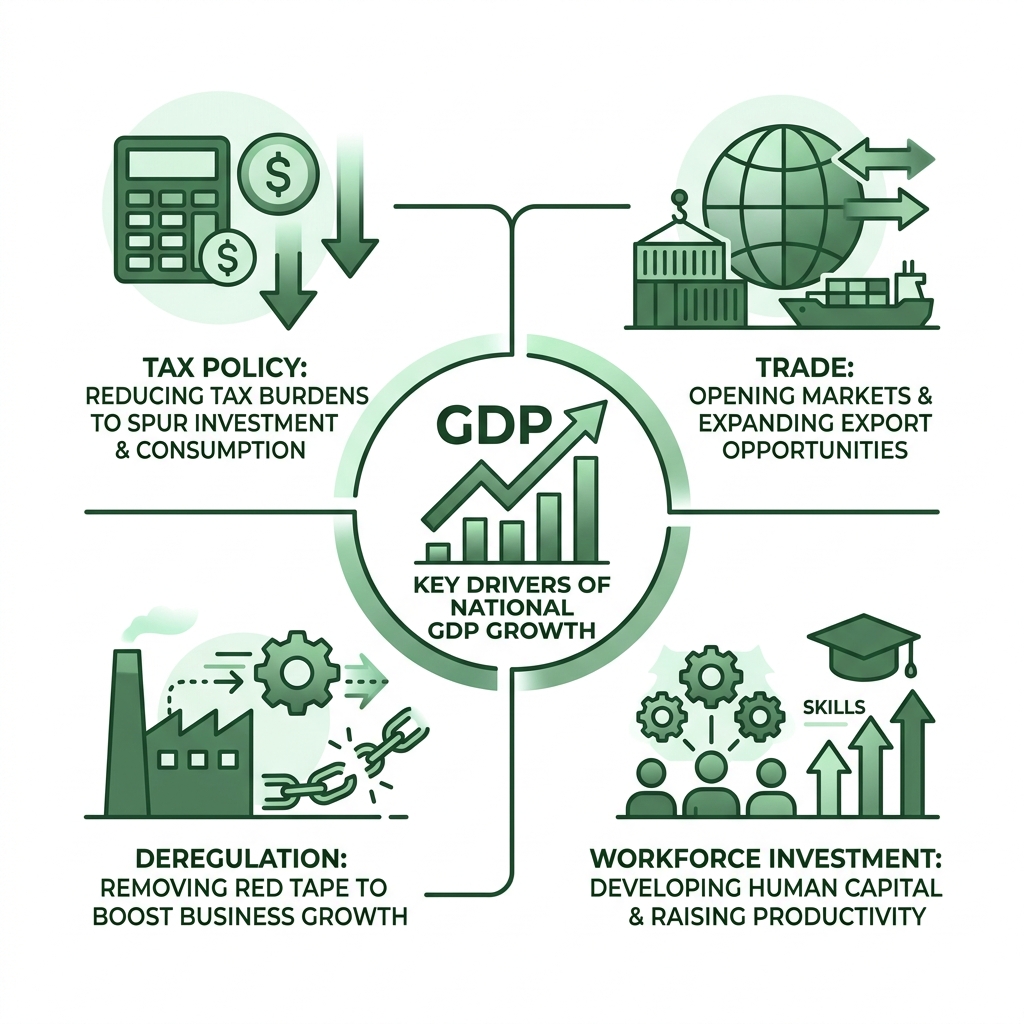
Economic growth policies are the government decisions that shape how fast an economy expands, how many jobs get created, and how much money families take home. Here are the core types that drive national prosperity:
| Policy Type | What It Does | Example |
|---|---|---|
| Fiscal Discipline | Controls debt and deficit to stabilize interest rates | Balanced Budget Act |
| Tax Reform | Lowers rates and expands incentives to spur investment | 2017 Tax Cuts and Jobs Act |
| Trade Expansion | Opens foreign markets to grow exports and jobs | NAFTA, trade deals |
| Human Capital Investment | Builds workforce skills to raise productivity | Education, job training |
| Deregulation | Removes red tape blocking business growth | Permitting reform, NEPA changes |
| R&D and Innovation | Funds technology that drives long-term productivity | R&D tax credits, STEM programs |
Getting these policies right means more jobs, higher wages, and stronger communities. Getting them wrong means slower growth, rising costs, and families left behind.
Every administration faces the same core challenge: how do you grow the economy fast enough to raise living standards without blowing up the national debt or leaving working people behind? There’s no single answer — but history shows that the right mix of open markets, fiscal responsibility, and smart investment in people consistently delivers results.
I’m Shay Williams, a retired U.S. Coast Guard Commander who spent over 30 years leading high-stakes operations and now advocates for common-sense economic growth policies that put Tampa Bay families first. My campaign for Florida’s 14th Congressional District is built on the same results-driven approach I applied throughout my military career.
Core Pillars of Modern Economic Growth Policies

When we talk about economic growth policies, we are looking at a multi-faceted strategy. In the Tampa Bay area, we see how national decisions impact our local ports, small businesses, and housing market. To understand how we move forward, we must look at the established pillars of growth: fiscal discipline, open markets, and human capital.
The U.S. Department of the Treasury plays a massive role in this. Their Office of Economic Policy doesn’t just crunch numbers; they analyze financial market developments and domestic issues to help determine which policies will actually move the needle. One of their key metrics is “Total Taxable Resources” (TTR), which estimates the fiscal capacity of states. This data helps us understand the economic health of regions like Florida and ensures that federal policy isn’t flying blind.
Historically, the most successful growth eras utilized a “tripod” approach. For instance, during the 1990s, the strategy focused on opening foreign markets, investing in American people, and maintaining strict fiscal discipline. This coordination was led by the National Economic Council (NEC)—created in 1993 to harmonize domestic and international policy—and the Council of Economic Advisers (CEA). Key figures like Robert Rubin and Janet Yellen were instrumental in these efforts, proving that when the White House coordinates its economic message, the private sector responds with confidence.
The Role of Fiscal Discipline in Economic Growth Policies
We believe that you cannot borrow your way to permanent prosperity. Fiscal discipline is the bedrock of economic growth policies. When the government spends beyond its means, it drives up the debt-to-GDP ratio, which can lead to higher interest rates for your mortgage or car loan.
According to A Pro-Growth Agenda to Strengthen the American Economy, the U.S. federal debt now roughly equals our annual economic output. This is a historic high. To fix this, we need a balanced approach:
- Entitlement Reform: Social Security and Medicare are vital, but without reform, interest on the debt and these programs will consume the vast majority of federal revenue by 2029.
- Deficit Reduction: Lowering the deficit reduces the “crowding out” effect, where government borrowing makes it harder for private businesses in Tampa to get affordable loans.
- Spending Restraint: We must prioritize productive investments—like infrastructure—over wasteful bureaucratic expansion.
Strategic Advisory and the National Economic Council
Effective policy requires more than just good intentions; it needs evidence-based modeling. The NEC serves as the “air traffic controller” for economic policy, ensuring that the Treasury, Labor Department, and Commerce Department aren’t working at cross-purposes.
Advisors like Laura Tyson and Joseph Stiglitz pioneered the use of Weekly Economic Briefings to analyze how global shifts—and even issues like climate change—affect the American wallet. By using “dynamic scoring,” policy experts can predict how a tax cut or a new regulation will actually change human behavior, allowing us to choose the path that maximizes growth while minimizing debt.
Tax Reform, Deregulation, and Privatization
If you want more of something, you tax it less. If you want less of something, you regulate it more. It’s a simple concept that often gets lost in Washington. For our neighbors in the 14th District, economic growth policies must focus on making the United States the most competitive place in the world to start and grow a business.
At the heart of this is the Tax Cuts and Jobs Act (TCJA). We advocate for making these reforms permanent. Without an extension, Americans could face a staggering $4.5 trillion tax increase. Key provisions like the 199A deduction for pass-through businesses are lifelines for the “mom and pop” shops that define Tampa’s economy. By allowing “full expensing,” we encourage companies to buy new machinery and technology today, rather than waiting years to write off the cost. You can learn more about how we are working-for-you to keep more money in your pocket.
Streamlining Regulations and Permitting Reform
Regulations often act as a hidden tax. Did you know that some infrastructure projects take nearly a decade just to get environmental clearance? Under the National Environmental Policy Act (NEPA), the time to complete a highway study grew from 2.2 years in the 1970s to over 8 years recently.
We need “One Federal Decision” policies that set hard deadlines for bureaucratic reviews. This is especially critical for:
- Energy Infrastructure: Speeding up permits for pipelines and transmission lines to lower your utility bills.
- AI Sandboxes: Creating safe zones for tech companies to innovate without being strangled by red tape.
- Financial Reform: Repealing the most burdensome parts of the Dodd-Frank Act, which often protects “too big to fail” banks while hurting local community banks in Florida.
Privatization and Federal Asset Management
The federal government owns roughly 640 million acres of land and 89% of all student loans. This is an incredible amount of capital locked away in inefficient government silos.
Pro-growth policies suggest that we should look at privatizing assets that the private sector can manage more effectively. This includes:
- The Strategic Petroleum Reserve (SPR): Selling off excess oil reserves to pay down debt.
- GSE Reform: Transitioning Fannie Mae and Freddie Mac out of government conservatorship to protect taxpayers from future bailouts.
- Student Loan Origination: Moving back toward a market-based system that encourages universities to keep tuition costs down.
Human Capital and Global Trade Expansion
Growth isn’t just about spreadsheets; it’s about people. To sustain a “Golden Age” of prosperity, we must expand our reach into global markets while ensuring our workforce is the most skilled on the planet.
Trade agreements like NAFTA (and its successor, the USMCA) created one of the largest free trade zones in the world. By lifting tariffs, we opened the door for Florida’s agricultural and manufacturing sectors to export more goods. Similarly, establishing Permanent Normal Trade Relations (PNTR) with China was intended to integrate them into a rules-based system, though we now know we must be more vigilant about protecting our intellectual property.
The United Nations Goal 8: Economic Growth highlights a global challenge: nearly 58% of workers worldwide are informally employed. In the U.S., our goal is “decent work”—jobs that provide fair income, security, and prospects for personal development.
How Trade and Innovation Shape Economic Growth Policies
We cannot win the future using the tools of the past. A “techno-economic” agenda is required to stay ahead of competitors like China. This means:
- Doubling the R&D Tax Credit: Increasing it from 20% to 40% to keep innovation on American soil.
- Intellectual Property Protection: Partnering with agencies like the USPTO to ensure American inventions aren’t stolen.
- National Competitiveness Council: Establishing a dedicated body in the White House to coordinate the global technology race.
Investing in the American Workforce
Productivity is the engine of wage growth. When a worker can produce more in an hour thanks to better tools or training, their value—and their paycheck—goes up.
Our focus must remain on:
- Vocational and Apprenticeship Programs: Not everyone needs a four-year degree. We need to support the trades—plumbers, electricians, and technicians—who keep Tampa running.
- High-Skill Immigration: We should welcome the “best and brightest” who want to start companies here, while ensuring our border is secure first.
- Pell Grant Reform: Making sure financial aid is tied to programs that actually lead to high-paying jobs.
Challenges and Barriers to Sustained Expansion
Despite our potential, several “potholes” threaten to slow down our economic engine. As your representative, I believe in being honest about these risks.
1. Trade Uncertainty and Tariffs: While tariffs can be a tool for negotiation, they are also a tax on consumers. In 2018, the average U.S. tariff rate rose from 1.5% to 2.6%. Since over 60% of imports are “intermediate goods” (like steel or machinery used by American factories), these costs can lead to higher prices for you.
2. Deficit Spending and Inflation: Adding trillions to the deficit when we are at near full employment is like pouring gasoline on a fire. It creates a short-term “sugar high” but leads to long-term inflation and forces the Federal Reserve to keep interest rates elevated.
3. Labor Shortages: With over 7 million job openings nationwide, businesses are struggling to find workers. While we must protect American jobs, we also need a legal immigration system that meets the needs of our economy without depressing wages for native-born workers.
4. Budget Gimmicks: We must move away from “current policy baselines” that hide the true cost of spending. Transparency in the budget process is the only way to restore trust in Congress.
Frequently Asked Questions about Economic Growth Policies
What are the most effective economic growth policies for long-term prosperity?
The “Gold Standard” involves a combination of permanent tax relief (to encourage investment), aggressive deregulation (to lower business costs), and fiscal discipline (to keep interest rates low). Additionally, investing in R&D and vocational training ensures that the workforce can handle the high-tech jobs of tomorrow.
How do trade agreements like NAFTA impact domestic economic expansion?
Trade agreements expand the “customer base” for American products. By removing tariffs, these deals allow Florida companies to sell more goods abroad, which supports local jobs. However, they must be paired with strong enforcement to prevent unfair trade practices and currency manipulation.
Why is fiscal discipline considered a cornerstone of growth-oriented policy?
When the government competes with the private sector for loans to fund its debt, interest rates go up for everyone. Fiscal discipline ensures that capital remains available for families to buy homes and for entrepreneurs to start businesses. It also prevents the “inflation tax” that devalues your hard-earned savings.
Conclusion
Sustained economic growth isn’t a miracle; it’s the result of deliberate, common-sense choices. By prioritizing productivity, rewarding work, and getting the government out of the way of Tampa Bay’s innovators, we can ensure a prosperous future for Florida’s 14th District.
Our mission is to bring Republican leadership back to the House to champion these economic growth policies. We are fighting for a stable economy where a single income can support a family, where small businesses can thrive without fear of the next tax hike, and where our children have the skills to lead the global economy.
Together, we can move past the era of “sugar-high” economics and build a foundation of permanent prosperity. We are working-for-you to make the American Dream a reality for every resident of Tampa Bay.